|
In this section, we will discuss several important questions that you might have on the constuction of active
loudspeakers.
Have you ever wondered how a small wall plug-in supply for active loudspeakers intended for multimedia-PCs could possibly deliver as much as 1000 watts? Or how a ghetto blaster might boom 200 watts into the street, when it is supplied by batteries which are barely capable of providing five watts of input power? Now look at a professional public address amplifier, which might have a weight of 30 kgs, but is modestly specified at 500 watts power
output.
Obviously, most of these power figures were not achieved by careful measurements in the manufacturer's lab. Instead, they have been "brainstormed" by the marketing department with the thought in mind that "watts" are still considered as an indication of audible quality by most
customers.
So you might ask yourself whose power figures you would accept as the truth? As a rule of thumb, we can say that the cheaper a product is in manufacturing, the more likely it is to have watts figures that are far removed from reality. Big numbers should make you doubtful, really. But ...
Whenever we discuss audio quailty, it does not matter if a product actually has so-and-so many watts
or if it does only in the minds of the marketing people!
As a matter of fact, it is quite simple to predict how many watts any amplifier can be reasonably expected to deliver. An amplifier's output power can never be greater than the maximum power delivered by ist supply. Actually, it is some 20% less, because some of the power is inevitably turned into heat. The typical power supply used for PC-multimedia loudspeakers will provide between two and ten watts, and much the same could be said about the batteries used in a portable radio. But if an amplifier would really have to deliver 100 watts, its supply must be capable of providing 120 VA (= 120 watts) to make sure that the amplifier produces clean, dynamical audio. So you can tell how many watts an amplifier has by just looking at the rating of the
transformer.
All amplifiers made by Thommessen are equipped with toroidal transformers which are 20% to 30% more powerful as they should nominally be. Just to make things as transparent as possible for our customers, it is part of our business agenda to never publish figures like "musical power" or "PMPO". Instead, we will only publish the rather conservative nominal power, ie. The RMS power delivered to a load of 4 / 8 ohms at full level (=1%THD).
return
You will have to keep in mind that one Watt (!) of power delivered by a hi-fi system is enough to make normal conversation
impossible.
But if you want to raise the level to an extent where it is audibly louder, you will have to increase the power by a factor of four. This means that a 100 watts amplifier is not remarkably louder than an amplifier of 50 watts. You will have to use a 200 watts amplifier to make an audible
difference.
In amplifiers, wattage is much less important than stability. A badly designed 100 watts amp will sound stressed and lack smack even when it only has to deliver 50 watts, while a good 50 watts amp will perform well up to ist power
limit.
Actually, 50 ... 80 watts are plenty enough to get into serious trouble with your neighbours if they don't share your taste in music. Buying a power amp capable of delivering more than 200 watts doesn't make sense really if you don't listen very loud and live in the country. On the other hand, you might use a 200 watts amp far below its power limit, considering the abundace in power as a reserve for strong bass transients, which will be convincingly produced only if you have some headroom in your power
amp.
return
"Will this amp also be able to handle a 2 ohms load?" This is a common question, and many of our customers are surprised when we answer: "Certainly not!". One important aspect lies with the reduced damping factor that is inevitable when you drive a 2 ohms load (see THOMMESSEN / Specifications - see what you will get / damping factor). Also, we will have to consider following
aspects:
-
An amplifier working on a 2 ohms load must deliver double the power as with a 4 ohms load, quadruple the power as with a 8 ohms
load.
-
The heat sinks must offer half the thermal resistance, i.e. be twice as large as those needed with a 4 ohms
load.
-
The output transistors must handle twice the thermal
dissipation.
This means that an amplifier designed for a 2 ohms load is much more expensive. However, 99.9 % of all hi-fi speakers have an impedance of 4 ohms or more. This means that you would invest a lot of money for a mostly useless feature.
Actually, this shows why expensive high end ampifiers are equipped with large power transfomers and heatsinks. A stereo amp designed to deliver 2 x 100 watts into 8 ohms would have to be equipped with a 1000 watts transformer to work on a 2 ohms load. This also explains why these amplifiers are prohibitively expensive.
Once again, it is quite simple for you to check if an amplifier is really designed for 2 ohms: If it is able to deliver 100 watts into 4 ohms, it would need a 250 VA(=watts) transformer to drive a 2 ohms load with the resulting power of 200 watts. You can also consult the measurements published in hi-fi magazines, which will reveal if an amplifier is really able to reliably deliver power into 2 ohms, or if it just "barely survives" the low impedance. Just check if its power is actually doubled in comparison with the 4 ohms load. If power goes up only by a small amount, this is not really a product that should be advertised as a "2 ohms amplifier".
On these grounds, you will understand that we answer your question with "Certainly not!", because we produce reliable components for a reasonable price and provide you with honest, down-to-earth answers instead of
hype.
return
We recommend that you use either closed or vented enclosures for your active subwoofer. If you want to make use of a module incorporating bass boost, a closed box is preferable. The electronic boost will compensate for the loss of deep frequencies, resulting in a subwoofer that sounds very punchy and
precise.
When using a vented enclosure, you should use only a small amount of bass boost, because higher levels of boost can have a diminishing effect on the quality of bass reproduction in the deepest frequencies. This is not a flaw of our module, it is simply a logical result of the enclosure principle and predicted by Thiele/Small
theory.
Bandpass-, TML or horn systems are not the best choices for a subwoofer enlosure. You should not use bass boost with these systems, as the drivers become unloaded below the system resonance, resulting in large diaphragm movements which can damage the driver permanently. When the loudspeaker makes a clacking noise, it might already be damaged, because this noise results from the voice coil knocking against the magnet's anchor plate. With bandpass subwoofers, you can also run into the problem that the module's lowpass filters do not work properly due to the natural lowpass behaviour of the
enclosure.
return
A subwoofer has to transfer vibrations to the air by moving its diaphragm. The most important factors for powerful bass reproduction are the size of the woofer and its diaphragm excursion. Any given sound level can be reached either by a large diameter woofer with small excursions, or a smaller diameter woofer with larger excursions. Obviously, the excursion in smaller woofers must be considered as a limiting factor, so you can expect a large diameter woofer to perform better and offer greater dynamic headroom. On the other hand, it is also true that large diaphragms have greater mass, which might impair precision und speed in bass reproduction.
A good compromise is realized by employing a number of smaller drivers in a subwoofer. We recommend two to four drivers with a diameter between 15 cm and 25cm. This arrangement offers the same diaphragm area as a larger driver, but with reduced mass, resulting in a more precise bass
reproduction.
Sensitivity is another factor influencing the choise of a driver. Normally, the sensitivity figure tells you the sound pressure a driver will produce in 1 m distance when driven by a signal of 2.8 V (= 1 W over 8 ohms / 2 W over 4 ohms). When comparing sensitivities of different drivers, you should always know at which frequency the measurement was taken. It does not make sense really to know a subwoofer driver's sensitivity at 1000 Hz. It is much more realistic to compare values at 50 Hz.
A high sensitivity subwoofer will play louder and more dynamically. Keep in mind that a reduction in sensitivity by 2-3 dB does effectively mean that you will have to use twice the power for the same loudness
level.
return
A correctly made subwoofer enclosure would typically consist of 19 mm MDF or chipboard to supress cabinet wall resonances, and you might use even thicker or more dense walls or additional strutting to make the enclosure as stable as possible. In regard to acoustic damping, the subwoofer module's front panel with its 4 mm sheet aluminium is certainly much inferior to a cabinet wall made of highly damped material which has five times the
thickness.
We always recommend mounting the module in its own sub-enclosure made from 9 mm chipboard. This will improve damping and also prevent the electronics from the fine dust of the damping material as well as the pressure waves resulting from the driver's
excursions.
For optimal thermal dissipation, the module must always be mounted vertically, thus warranting a chimney effect in the heatsink's ribs that will care for a constant movement of air through its structure. You should never mount the module horizontally or
upside-down.
return
Many decoders do already offer a filtered mono output for the connection of a subwoofer. Our modules are equipped with a stereo input, but it is quite easy to use them in this
configuration:
-
use a Y-adapter to connect the subwoofer's stereo input to the decoder's mono output
-
set the subwoofer's filter to the highest frequency or use "filter bypass" to prevent unwanted interaction of the subwoofer crossover with the decoder's inbuilt
crossover.
Note:
You should never use a Y-adapter to turn a preamplifier's or decoder's stereo output into a mono output. This could easily damage your preamp/decoder! Converting stereo to mono should always be left to the subwoofer
electronics.
return
Please take your time when placing the subwoofer in your listening room. It is often assumed that a subwoofer could be placed anywhere in the room, but this is not true. Please consider following tips and
suggestions:
Optimally, the subwoofer should be placed away from the walls, with a distance of 0.5 m to the next wall. If you will have to place the subwoofer close to a wall or in a room corner, bass might be sounding imprecise and boomy. It might demand a number of listening tests to find a compromise between acoustic performance and reasonable placement in regard to interior decoration and
convenience.
It is also important to find a good relative placement between the subwoofer and the satellites, as this can dramatically change the quality of reproduction, acoustically integrating the subwoofer rather than making it audible as a distinct
channel.
Therefore, it is important that the soundwaves from both satellites and the subwoofer will reach the listening position at the same time, i.e. they should have the same distance to the listening position. The optimum position of the subwoofer is right in the middle between the satellites. Following illustrations will show some typical configurations.
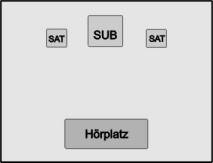
excellent - the subwoofer is placed centrally between the satellites. All three loudspeakers have the same relative distance to the
listener.
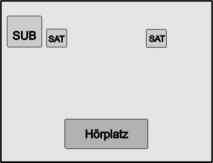
good - All three loudspeakers have the same distance to the listener. But since the subwoofer is placed outside of the plane of the satellites, you should set the subwoofer cutoff to 80 Hz or
lower.
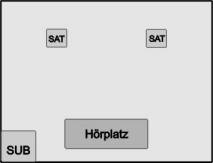
Not recommended - the subwoofer is closer to the listener now. This means that the soundwaves from the satellites are perceived later. This could lead to an impaired reproduction of low
frequencies.
return
The human ear is not able to clearly locate a sound source radiating very low frequencies. But there is no distinct upper frequency limit for this effect - as a matter of fact, our sense of location improves slowly over a range of
frequencies.
Thus, it is generally preferable to crossover a subwoofer as low as possible, as this tricks our hearing into believing it is actually a part of the satellites rather than a distinct woofer channel. A deeper cross-over frequency is generally recommended because it leads to a more homogeneous sound. The reason is that the subwoofer cannot be acoustically located. Still you have to take into account that a cross-over frequency of, say, 50 Hz requires a satellite speaker which can relay 50 Hz in line. A high cross-over frequency puts less emphasis on the satellite speakers but the downside ist that the subwoofer can then be heard. Choosing a higher crossover point will put less stress on the satellites' woofers, but it also might make the position of the subwoofer rather
obvious.
You should set the subwoofer to 80 Hz before you proceed with your listening tests. Now try to find the best setting for your combination of satellites and subwoofer.You can also try to spread the crossover point by using different settings for satellites and subwoofer, respectively. Then optimum is found when all three loudspeakers seem to blend in to a system, where the bass is not noticed as a distinct
channel.
Note:
The satellite crossover might considerably change the reproduction of higher
frequencies, because:
- the satellite amplifier does not have to provide high power for bass transients now
- the satellite woofers' excursions are much reduced
These new conditions for the amplifier and the satellite woofers will change the character of reproduction. This inevitably follows from the new principle applied and is not a flaw of the active
crossover.
If you think that this change is not to your liking, you could try to run the satellites fullrange, i.e. unfiltered. The subwoofer will then only provide the deepest frequencies which are not reproduced by the satellites. Mind that you might easily damage the satellites in this configuration, as the subwoofer might cover up any distortion produced by the satellites when they are overdriven in the bass
range.
return
Bass boost is a means of extending the lower "natural" frequency limit of a subwoofer. It works by providing additional power in a range where the woofer would normally drop off in its
response.
This boost must not to be confused with the function of an amplifiers bass pot or an equalizer. Boost is working on a much more restricted part of the bass spectrum: If set to 30 Hz, frequencies of 60 Hz are already left unchanged. This means that the boost function does not lead to unwanted colouration of higher bass
frequencies.
Please also read "choosing the right subwoofer enclosure " for further information
Important note:
A 6 dB boost means that power is quadrupled !
return
|
