 |
|

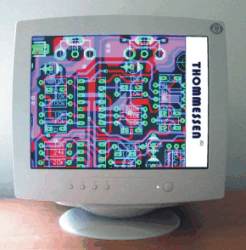
In the next step, we will design a printed circuit board from the circuit topology. This can be quite time-consuming and demands a lot of experience, because the dimensioning and placing of a single track might have a noticeable influence on the performance. In a parallel step, we will develop the mechanical components, i.e. enclosure front, casing, switches and connectors will be placed, resulting in exact
drawings. |
|
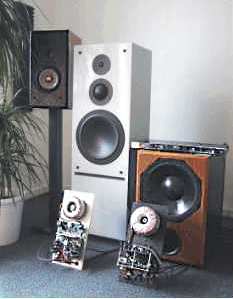
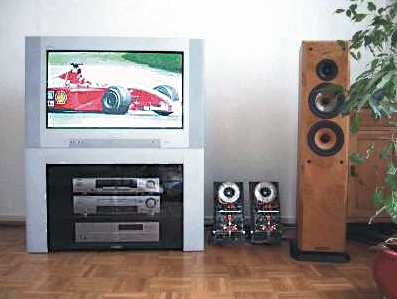
After building a prototype, we will measure the performance and compare the resulting data with our simulations. This is followed by subjective evaluation in extensive listening test, where the prototype must show its ability to convince the most critical listener. For subjective evaluation and comparison, we employ top class audio components and loudspeakers from renowned manufacturers. This means that our products are not only technically, but also subjectively compatible with nearly all existing high perfomance audio
components.
 |
 |
A pilot series is produced only after a product has successfully passed the aforementioned tests. The pilot will also undergo an extensive test procedure involving messurements and listening tests, before it is released into series
production.
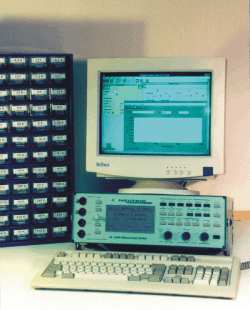
Before assembly, each circuit board is controlled by a programmable, Windows-controlled QC measurement computer. Measurements include frequency and phase response, harmonic distortion, spectral analysis, crosstalk and noise. The results are compared against the reference values measured on the prototype. Each circuit board has to pass this automated test with flying colours before it is released into production. Assembly is followed by visual inspection and additional measurements, this time concentrating on controlling and adjusting all reference voltages. QC is concluded by an extensive burning-in test. This means that our products have been thoroughly checked in regard to all possible conditions before they are packed and delivered. |
|
2) THOMMESSEN -
renowned O.E.M source manufacturer
Apart from our own product line, we are also known throughout the trade as an O.E.M. manufactur, producing top class electronics sold under other brand names. Some of our O.E.M. products:
|
|
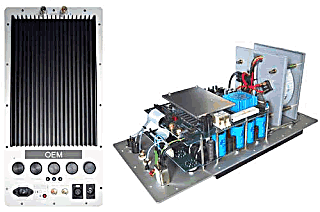
Subwoofer module incorporating a 1 KW double mono power amp, weight 15 kg, height 0.5 m, employing a Linkwitz filter with sophisticated correction circuitry for linear frequency and phase response. |
|
|
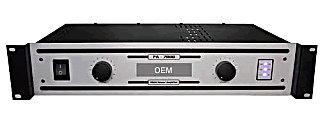
Voltage controlled audio power meter 2 x 500 W for 19" rack mounting. Incorporating automatic logarithmic conversion and ground lifted inputs for maxium safety even when the input is reversed. |
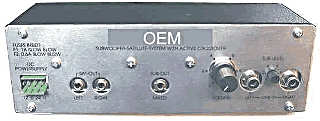 |
Subwoofer/satellite amplifier module for series produced multimedia personal computers, dedicated for professional applications as info terminals in museums, railway stations, exhibitions etc. |
 |
Public address amplifier in 19" enclosure. Temperature controlled fan, output protection employing super fast opto couplers. Connection via Speakon, binding post, XLR and Cinch. |

Please contact us if you need custom solutions for technical problems or professional help in research and development, construction or assembly of your
products.
3)
Specifications - see what you will get
Technical specifications outline a product's basic performance. This means that manufacturers of audio equipment might publish seemingly comprehenisve figures like power output or distortion, which are, as a matter of fact, no more relevant than simplistic advertising blurbs, because their meaning is not clearly defined.
Distortion
For an amplifier's sound quality, distortion figures are not as relevant as it might seem, because there is no noticeable difference in, for instance, 0.001% and 0.01% THD. Sound quality is not depending on the sum of all harmonics (THD), but on their distribution and relative amount. This means that an amplifier with a somewhat higher THD might actually sound better than another amp that has been optimised for low THD by sacrificing other parameters.
Power Output
Wattage is often seen as the most important parameter, which means that the published figures are most likely to be rounded to higher values. As a matter of fact, an amplifier's maximum power output is solely dictated by its power supply. A rule of thumb: An amplifier can only deliver 80% of the power that is offered by the supply. The remaining 20% are dissipated as heat.
This is the reason why we would never publish misleading figures like pulse, PMPO or musical power. Our products' power output is clearly specified as RMS power delivered into a load of 4/8 ohms at full level (= 1%
THD).
You cannot say it too often:
Amplifier Wattage is not an indicator of audio quality!
Damping factor
For an amplifier's audio performance, damping factor is much more important than high power output. A higher damping factor means better control of the loudspeaker, especially in the bass range. Please keep in mind though that damping factor will always decrease with the load
impedance.
In practice, this means that using a box with a lower impedance, i.e. 4 ohms instead of 8, will raise the amplifier's output power, but also lower the damping factor, which might seriously impair the performance. Therfore, it is not recommended to use a 2 ohms box, because the advantage of having maximum sound pressure raised by 2...4 dB does not really balance out the loss in damping, which will make the bass sound wooly and
compressed.